Kane
The Prophet · Brotherhood Leader · Eternal
Kane is the central figure of the entire Tiberium saga — and one of the most compelling villains in video game history. Charismatic, ancient, and seemingly immortal, he leads the Brotherhood of Nod across nearly a century of conflict, from the First Tiberium War in 1995 to the conclusion in 2077. He is the architect of every major event in the Tiberium timeline.
His true identity is never explained. He appears in photographs from the early 20th century and claims to have watched humanity since its beginning. Whether he is an alien agent, a temporal anomaly, or simply a man who has found a way to cheat death is deliberately never answered. The ambiguity is the point.
The Immortality
In every game Kane appears to die — shot through the chest in Tiberian Dawn, caught in a GDI Ion Cannon strike in Tiberian Sun, impaled on a crystal in C&C3 — and in every game he returns. His survival is presented not as a miracle but as an inevitability. Kane is not a man who can be killed. He is an idea.
The Grand Plan
Kane's true goal — revealed in Tiberian Twilight — was never world domination. He wants Ascension: to use the Scrin's Threshold Tower to transport himself and the Brotherhood beyond Earth entirely. Tiberium was always a means to this end. Every war, every manipulation, every apparent defeat was a calculated step toward opening that door.
Global Defense Initiative
GDI · United Nations Peacekeeping Force · Defenders of Humanity
Formed from a United Nations peacekeeping mandate, GDI is humanity's institutional response to the Brotherhood of Nod. They represent established order, scientific progress, and the defense of stable Blue Zone populations. Funded by first-world nations and equipped with superior technology, GDI fields heavier armor and more advanced weapons than Nod — but is slower to react and more constrained by politics.
Evolution Across the Series
In Tiberian Dawn, GDI is the reactive defender, chasing Kane's forces across multiple continents. By Tiberian Sun, a devastating Nod opening strike has left them battered and the world half-dead around them. In C&C3, GDI governs a dying Earth from protected Blue Zones, administering what is left of civilization. By Tiberian Twilight, GDI and Nod have become reluctant partners under Kane's direction — the war finally over, replaced by a desperate race to save the planet.
The Ion Cannon's Terrible Mistake
GDI's most defining moment is also its greatest manipulation. In C&C3, Kane engineers GDI into firing their orbital Ion Cannon at his own Temple — which was packed with liquid Tiberium. The explosion sends a resonance signal into deep space, summoning the Scrin. GDI's ultimate weapon was turned into the key that unlocked an alien invasion.
Brotherhood of Nod
Religious Order · Global Network · Kane's Army
The Brotherhood of Nod is simultaneously a decentralized global terrorist organization and a genuine religious movement. Nod draws its followers from the world's dispossessed — the poor, the displaced, populations abandoned by GDI's Blue Zone prosperity. To them, Kane is a genuine prophet and Tiberium is a transformative gift. They are not merely soldiers; they are believers.
Ideology
While GDI fights to contain and eliminate Tiberium, Nod embraces it as a catalyst for human evolution. Brotherhood soldiers willingly accept Tiberium mutation, becoming cyborgs or worse. Nod's entire civilization is built around Tiberium — its weapons, its power systems, its philosophy. Where GDI sees a poison, Nod sees a sacrament.
The Black Hand
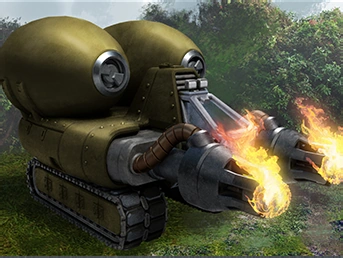
Within Nod's hierarchy, the Black Hand is Kane's elite fanatical order — his personal enforcers and ideological purists. They are focused on flame weapons and total devotion. Ironically, the Black Hand views Tiberium-enhanced soldiers with suspicion, believing in purification through fire rather than mutation. In Kane's Wrath, they become a playable sub-faction representing Nod at its most extreme.
Nod Without Kane
Every time Kane apparently dies, Nod fractures. Sub-commanders seize control, factional wars erupt, the organization splinters. This reveals something important about the Brotherhood: it is not an institution. It is a cult of personality. Without Kane, it collapses. With him, it is capable of coordinating global campaigns simultaneously across dozens of countries.
Tiberium
Alien Crystal · Terraforming Agent · The Resource That Dooms Earth
Tiberium is an alien crystalline substance that arrived on Earth in 1995 via meteor impact near the Tiber River in Italy — giving it its name. It spreads autonomously, converting organic matter and soil minerals into new crystal formations. It is energy-dense, mildly radioactive, and slowly toxic to most complex life. It is also the only resource both GDI and Nod can harvest at scale.
The Spread
By the 2030s (Tiberian Sun), Tiberium covers roughly half the Earth's surface. Red Zones — regions of extreme contamination — are uninhabitable without environmental protection. Yellow Zones are survivable but contaminated. Only Blue Zones, maintained by GDI's suppression technology, remain Tiberium-free. By 2077 (Tiberian Twilight), Earth is at the edge of becoming a dead world.
Origins: The Scrin's Farm
Revealed in C&C3: the Scrin seeded Tiberium on Earth deliberately, as they have done to dozens of other worlds. Tiberium is a terraforming agent — it converts a planet's biosphere into crystalline material suitable for Scrin harvesting. Earth was intended to be a Tiberium farm, its biological matter converted over centuries. The fact that humans developed enough to resist, and that a liquid Tiberium bomb detonated before the process was complete, was not part of the plan.
The Perverse Economy
Both GDI and Nod fund their war using Tiberium — the very substance destroying their world. This creates an inescapable contradiction at the heart of the Tiberium saga: the resource keeping the war going is the resource that will end all wars by ending all life. Neither faction can stop harvesting it without losing the ability to fight. The war cannot end until Tiberium does, and Tiberium will not stop until the war does.
The Scrin
Alien Harvesters · Tiberium Architects · Unexpected Invaders
The Scrin are the third faction in Tiberium Wars — ancient, alien, and utterly unlike anything Earth has produced. They seeded Tiberium on Earth as a routine harvesting operation, one of many they have conducted across the galaxy. They were not supposed to arrive until Earth was dead. The liquid Tiberium explosion brought them early, into a world that — against all their models — was still capable of fighting back.
Tiberium-Based Biology
Scrin technology is entirely Tiberium-dependent. Their units are powered by Tiberium, constructed from it, and designed to operate optimally in Red Zones where concentrations are highest. In Blue Zones they are weakened. Their structures do not build — they phase in from a dimensional rift, materializing fully formed from another plane of existence.
The Threshold Tower
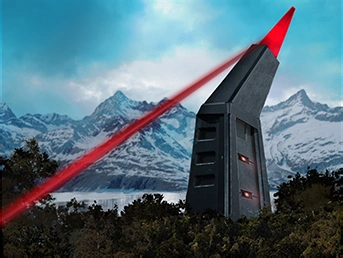
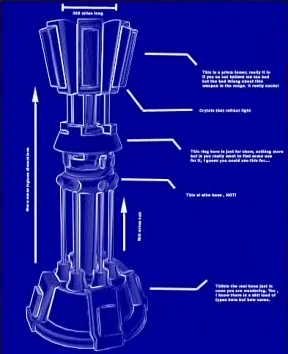
The Scrin's primary objective in C&C3 is constructing a Threshold Tower — a dimensional portal through which large-scale Tiberium harvesting would begin. GDI destroys all towers except one, protected by Kane's forces. Kane is the only human who fully understands what the Tower is for, and he has been working toward this moment for decades. His Ascension depends on it.
Scale and Perspective
The Scrin are not conquerors in the traditional sense — they are resource extractors encountering unexpected resistance. They have no concept of why primitive organisms would resist the harvest. To them, humanity's defense of Earth is as baffling as ants fighting back against a harvester. This indifference makes them more unsettling than a conventional enemy with recognizable motivations.
The Three Tiberium Wars
First War · Second War · Third War · Twilight
First Tiberium War — 1995 (Tiberian Dawn)
Kane reveals the Brotherhood to the world by seizing control of 51% of Earth's Tiberium supply. GDI hunts him across Africa, Europe, and the Middle East. The canonical outcome: GDI wins, the Temple of Nod is destroyed, Kane is apparently killed. But the Brotherhood survives, driven underground, and Tiberium continues to spread unchecked.
Second Tiberium War — 2030 (Tiberian Sun)
Kane returns after 35 years of presumed death, commanding a rebuilt Nod that strikes GDI simultaneously across the globe. The war is fought on a dying planet, with only pockets of habitable land remaining. Kane is destroyed in an Ion Cannon blast — but Tiberium's spread is not halted, and Nod's infrastructure survives. The world is worse for the war.
Third Tiberium War — 2047 (Tiberium Wars)
Nod attacks GDI globally, then the liquid Tiberium gambit summons the Scrin. GDI fights on two fronts simultaneously. Kane survives — again — and disappears through the remaining Threshold Tower. GDI wins but the planet is 40% Red Zone. The war technically ends but the crisis continues.
The Twilight — 2077 (Tiberian Twilight)
The conclusion. Earth is nearly gone. Kane approaches GDI with Scrin technology that can halt Tiberium's spread — but only if both factions cooperate under his direction. Nod fractures. A civil war erupts between those who follow Kane and those who reject the deal. In the end, Kane departs through the Threshold Tower with his followers, ascending to wherever he has been planning to go all along. The war ends not with a victory, but with Kane getting exactly what he always wanted.
The Einstein Paradox
Time Travel · Alternate History · The World Without Hitler
The Red Alert universe begins with a single act of good intentions gone catastrophically wrong. Albert Einstein, horrified by the destruction he witnessed in the 20th century, constructed a Chronosphere and traveled back to 1924 to prevent WWII by shaking hands with a young Adolf Hitler — erasing him from history entirely.
Without Hitler, the Nazi party never rose. But without a fascist Germany to unite the West against, the Soviet Union under Stalin faced no counterbalance to its expansion. By the 1950s, Soviet forces were rolling across Europe. The resulting war — the Allies versus the Soviets — was larger and more devastating than the one Einstein had prevented. He solved one problem and created a worse one.
Branching Timelines
Red Alert 2 confirmed that Einstein's tampering created a branching timeline rather than a replacement. Red Alert 3 deepened this: Soviet time agents traveled back to eliminate Einstein himself, creating yet another branch — one where the Empire of the Rising Sun arose as a third superpower. Each game is set in a different branch of the same initial paradox.
The Factions of the Red Alert Wars
Allies · Soviets · Empire of the Rising Sun
Allied Forces
A coalition of Western democratic nations, the Allies represent technology, precision, and adaptability. Their doctrine favors quality over quantity: individual units are smarter and more capable than their Soviet counterparts. The Chronosphere, Prism technology, and Chrono teleportation make them the most technically sophisticated faction — but individually fragile under Soviet mass assaults.
Soviet Union
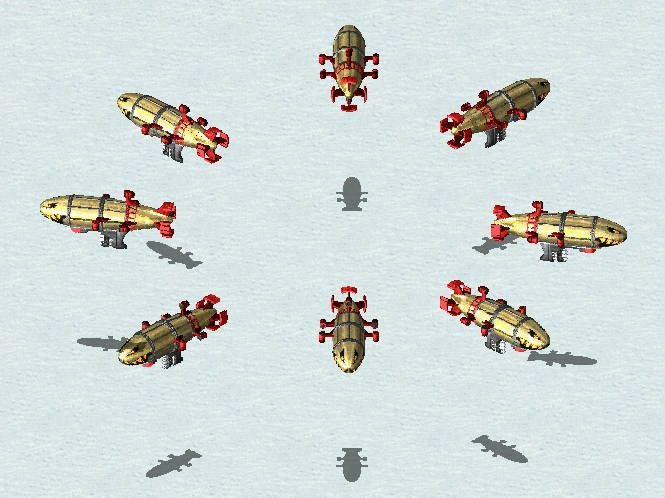
The Soviets are the faction of brute force and overwhelming numbers. Their technology is blunter than the Allies' but their production capacity and unit durability allow them to absorb losses that would end any Allied operation. Tesla weapons, Apocalypse Tanks, Iron Curtain shields, and Kirov Airships represent a military philosophy where more is always the answer.
Empire of the Rising Sun
The Empire is the most unique faction in the Red Alert series. Created from the alternate timeline where Einstein was eliminated, imperial Japan developed independently into a technological superpower combining feudal tradition with advanced robotics. Every unit transforms. Every commander is a warrior-aristocrat. Their doctrine is surprise, speed, and spectacle — a different kind of power from both Allied precision and Soviet mass.
Yuri
Psychic Advisor · Hidden Mastermind · Third Faction
Yuri appears in Red Alert 2 as Premier Romanov's psychic advisor — the architect of the Soviet invasion of the United States, designer of the Psychic Amplifiers that facilitated it, and the most dangerous mind in the war. He seems to be a loyal Soviet instrument. He is not.
Yuri's actual objective is global psychic domination through a network of Psychic Dominators — devices powerful enough to mind-control entire continents simultaneously. The Soviet invasion was a distraction. He needed both superpowers tied up fighting each other while his own infrastructure was constructed in secret. Neither the Allies nor the Soviets were his target — all of humanity was.
Defeat and Punishment
In Yuri's Revenge, a Soviet time machine allows the Allies to travel back and dismantle Yuri's network before it activates. Yuri is ultimately trapped in prehistoric times by a malfunctioning Chronosphere, unable to return to the present — stranded millions of years in the past, his plans undone, his mind unable to dominate anything more complex than prehistoric fauna. A fate arguably worse than death for a man who believed he could control the world.
The Three-Way War
USA vs China vs GLA · Near-Future Conflict · No Tiberium, No Kane
The Generals universe is completely disconnected from the Tiberian and Red Alert timelines. Set in the near-future, it depicts a triangle of conflict between the United States' technology-dominant military, China's industrial and numerical superiority, and the Global Liberation Army — a stateless, decentralized terrorist network with no territory and no conventional military hierarchy.
The GLA
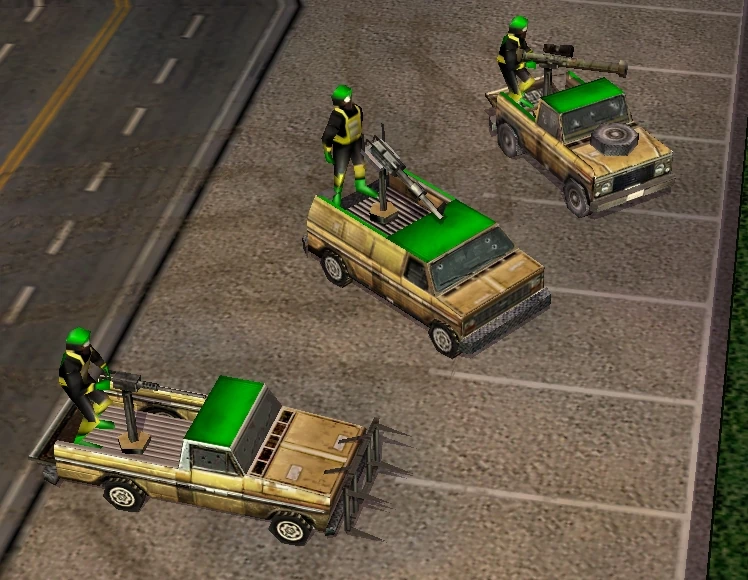
The GLA is the most unconventional faction in C&C history. They have no conventional base defenses, no heavy armor, and no air force — instead building tunnel networks, using scavenged and improvised weapons, deploying biological agents and suicide bombers, and hiding combat forces inside civilian structures. They fight a brutal guerrilla war against two superpowers and consistently punch far above their weight.
Unlike Nod, which has a clear ideological core in Kane, the GLA's motivations are deliberately ambiguous — they are anti-Western, anti-establishment, driven by grievance. Their strength is their adaptability: they can build anywhere, absorb losses that would collapse conventional armies, and scavenge weapon upgrades directly from destroyed enemy units.
General's Powers
Generals introduced the General's Powers system: as you score kills and complete objectives, you earn points to unlock special abilities — nuclear artillery, carpet bombing runs, Chinook reinforcement drops, propaganda broadcasts. Zero Hour expanded this into nine distinct sub-generals, each a hyper-specialist. The result was one of the most varied faction rosters in RTS history: every general plays differently even within the same parent faction.
Command & Conquer's Place in History
Westwood Studios · EA · The RTS That Defined a Genre
Command & Conquer was created by Westwood Studios in 1995, built on the foundation of Dune II (1992) — widely credited as the first modern real-time strategy game. C&C refined and popularized what Dune II had pioneered: base-building, resource harvesting, unit production, and combat on a single shared map. It added the crucial innovation of faction asymmetry — GDI and Nod played fundamentally differently — and made it accessible to a mass audience.
Westwood was acquired by EA in 1998. The studio continued producing C&C titles through the early 2000s before being absorbed and eventually closed in 2003. The franchise continued under EA Los Angeles and later EA Pacific. The series effectively concluded with Tiberian Twilight in 2010. An attempted free-to-play reboot was cancelled in 2013 after community backlash.
Frank Klepacki and the Soundtrack
The music of C&C is as inseparable from the franchise as Kane himself. Composer Frank Klepacki created the series' signature industrial rock-metal soundtrack across multiple games. Hell March from Red Alert is one of the most recognized pieces of video game music ever composed — a driving, aggressive anthem that perfectly captures the Soviet war machine aesthetic. Act on Instinct from Tiberian Dawn, Mechanical Man, Tiberium Rain — the catalog defined a sound that the genre has been chasing since 1995.
The Remastered Collection and the Community
In 2020, Petroglyph Games — a studio founded by former Westwood developers, the people who made the originals — partnered with EA to produce the C&C Remastered Collection. The full source code for both Tiberian Dawn and Red Alert was released publicly on launch day. The modding community immediately began producing new campaigns, balance improvements, and entirely new content. It was widely seen as the most respectful possible send-off to the games that built the genre.
C&C's legacy is not merely historical. The faction asymmetry it pioneered, the resource-harvesting loop it refined, the villain-with-a-point it popularized — these elements reverberate through every RTS made in the 30 years since Tiberian Dawn shipped. The genre remembers where it came from.